
外观
Prof. Amanda Karakas, from Monash University
警告
纯靠手动记录,但是鉴于对于本人这种入门者而言确实很困难,走神一下就听不懂了,因此多有缺漏. 故本篇仅供个人学习参考,最好不要外传误导他人.
一般认为铁元素是一个分界线,在铁之前的元素在恒星中可以被燃烧,更重的元素则通过中子捕获过程来合成.
Metallicity:就是所有重于 He 元素的其他元素之总和.
H 是宇宙中最 abundant 的元素. 当一颗恒星开始进行 pp-chain 反应时,它就进入了主序星序列. pp-chain 的完整反应将四个 H 原子核合成为一个 ,这个过程的能量很容易用质量变化来计算. 如果一颗恒星仅仅有 H 和 He,那么它的能量来源就只能是 pp-chain 反应;但是更重质量的恒星 (或者说更大多数的) 含有 C 或者 O 等等更重元素的气体,它们有更多的可能反应. 举个例子,在我们的太阳中 . 这使得 CNO 循环反应可能发生.
明显可以看出 CNO 循环对于温度的幂次高了很多. 在 质量左右,CNO 提供的能量开始大于 pp-chain.
主序星阶段末尾,H 被耗尽,越大的恒星这个过程进行得就越快;并且这个变化是相当显著的, 的恒星氦闪前的时间 (主序星阶段) 仅有 Myr 左右,而太阳的时间则有 Gyr. 这表明年轻的星系可能包含更重的星,而老的星系反之.
完了这里全是恒星与行星讲的东西...
RGB:针对我们的太阳,在 RGB 阶段会膨胀到 倍半径. 最终中心温度会达到能使得 He 开始燃烧,这需要 K. 之后进入稳定的 He 燃烧阶段,主要的反应是 triple- 反应,产生 ;接下来有一个要求稍高一点温度和密度的反应,可以生成 . 我们有
这造成一个巨大的 divergence,因此会产生很强的 convection.
first dredge up (也就是从主序星阶段到巨星分支前端的第一个 mixing event):表面同位素比变化,,……
在理论的 stellar model 中,我们只预言了一个 mixing event,但是观测证据表明有某种 chemical transport 存在于低质量的巨星外层中. 对于这个额外的 mixing,一个可能解释是在最外层 envelope 中有强烈的对流, cm/s;中间存在一个辐射区,完全没有对流;两者之间还有一个缓慢的对流区, cm/s,这导致 CNO 循环的产物被运输到恒星表面.
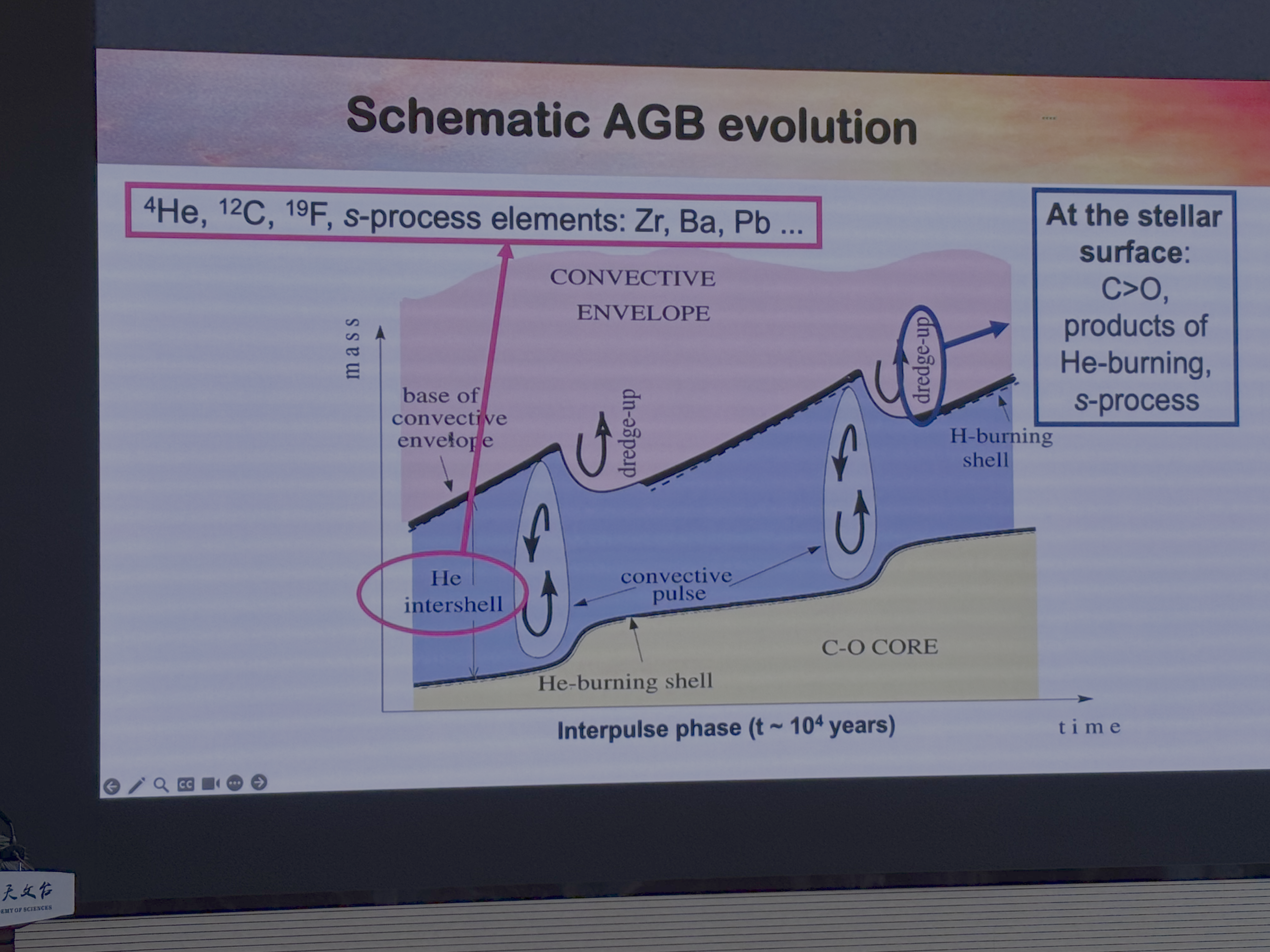
当 He 也被耗尽,恒星进入第二巨星分支,或者说 AGB. 这时候内核是 C/O 反应,一个 He 燃烧的 shell 在其周围建立;最终这个 shell 会逐渐消失. 主要结构大概是:C/O core, He burning shell, inter He shell, H burning shell.
Thermal Pulse Cycle:
On phase
The He shell flares up....way up! 100 million solar luminosities or more!
Drives a convective region from He shell to H shell (intershell convection)
Power down phase
He shell dies down
Convective region disappears
Dredge-up phase
Star expands and cools
Cooling means higher opacity and steeper gradient
Convection develops and moves deep into the star
Overlaps with the earlier intershell convective region
Mixes products of He-shell burning to the surface
Off phase ( few hundred years later)
He shell is off
H shell provides the energy
Until the next pulse...
这产生一个在恒星内部周期性的演化,如下图:
每一个周期结束之后几个区域的大小就会发生一次小的变化.
Carbon Stars:当 C/O 时,恒星表面是 "C rich" 的,这被称为 carbon star. 它们一般很亮.
Determining AGB masses is difficult. 甚至在 Gaia DR3 这种数据集中都很困难,因为它们的亮度一般有很大的误差.
carbon stars 的质量下限:实际上到现在为止这个问题并没有很好的解决,在历史上我们认为对于太阳的 metallicity,大约是 ,但是化学演化导致这个质量下限会被改变.
Hot bottom burning:这个过程也是一个中子捕获过程,它在 envelope 的底部进行,产生 N, Na, Al 等元素. 一般而言这个过程发生在 , 的恒星中.
总结一下 AGB 的组成:
C/O : for [Fe/H] C stars, ……
这些 AGB 一般是 s-process rich.
C/O :other masses compared to the former class; [Fe/H]
For ,在对流 envelope (Li, $^{13}$C, $^{14}$N, Na, $^{26}$Al) 中存在一个 H-burning 区域,s-process rich (?)
For ,只有 first dredge up & extra mixing,某种意义上仅仅是 RGB 加了两个特性 (?)
上面两个问号是 Amanda 加在 PPT 里面的.
AGB 很多都是 dusty (灰蒙蒙的),因为它们的星风会带出很多物质. 这会使得观测时的 flux 随时间变化比较明显,也增大了观测的难度.
提示
Summary - fate of low and intermediate-mass stars
一个 lead-in 的问题是,比 Fe 重的元素来自于哪里?从昨天的 lecture 我们已经知道是中子捕获过程,而其中的慢中子捕获 (s-process) 是一个重要部分. 我们想知道什么样的恒星能够发生 s-process. 在观测上,能够发现 AGB stars 中的 [s/Fe] ,也就是说它们有很高的重元素含量;在 post-AGB 阶段的恒星有时也能发现大量的重元素.
中子源:第一个发现的中子提供反应是
注意
显然我并不是很能理解这种核反应的写法... 查了一下之后发现意思是这样,
因此上面那一长串表示一串核反应的缩写.
另外, 的那个反应,是一个 衰变,右边产生一个 和一个中微子,所以没打逗号.
The effect of stellar rotation? 曾经人们认为这是其中的一个重要驱动力,但是根据对于 [Ce/Y] 的观测数据,加入旋转的模型实际上并不能拟合 [Ce/Y] - [Fe/H] 的观测数据.
Non-canonical mixing processes:很多不同的机制,比如 2025 年有人提出 GW 会对 Li 的生成造成影响;另外,磁场也是一个有力的机制.
/Definition/ (stellar yields)
恒星抛射出的质量 ;更精确地说,净 (net) 产率 (yield) 是指对于不同的物质 ,在恒星 lifetime 中积分出来的总抛出质量:
而总产率则包含了上面被减去的初始星风产率 (因为 stellar yield 的成分不只有星风),
提示
Summary (This is a summary for the former 3 lectures)
Amanda 做了一个 toy AGB model 来给大家玩,能够大致算出一个 AGB 阶段中大致经历了几个 pulse 周期、最终的演化结果等等.
## Based on a synthetic AGB evolution from Amanda Karakas (Monash University)
### Author of code template: Minjih Kim (2024)
###
import pandas as pd
import numpy as np

"""
Load data, initial composition
"""
df = pd.read_csv("init_composition.dat", sep="\\s+")
n_species = df.shape[0] #number of species

"""
Arrays
"""
size = 100
menv = np.zeros(size)
mtot = np.zeros(size)
mc = np.zeros(size)
dm_dredge = np.zeros(size)
dmc = np.zeros(size)
xenv = np.zeros((size, n_species))
L = np.zeros(size)
R = np.zeros(size)
header = ['timestep', 'M_c (Msun)', 'M_tot (Msun)', 'R (Rsun)',
          'L (Lsun)', 'X_surf_H', 'X_surf_He', 'X_surf_12C', 'X_surf_13C',
          'X_surf_14N', 'X_surf_15N', 'X_surf_16O', 'X_surf_17O', 'X_surf_18O',
          'X_surf_Sr', 'X_surf_Ba', 'X_surf_Pb']

"""
Helper functions
"""
def to_X(log_ratio, Asun, x): #convert abundance to X (mass fraction)
    At_x = df['At(i)'].loc[df['species'] == x].values[0] #find At(x), atomic mass of species x
    X_x_sun = 10**(Asun-12.0) * Xsun * At_x
    return X_x_sun * 10**(log_ratio)

def to_A(row, x, i): #convert mass fraction to A (abundance)
    At_x = df['At(i)'].loc[df['species'] == x].values[0] #find At(x), atomic mass of species x
    Y_x = xenv[row,i] / At_x
    return np.log10(Y_x/Xsun) + 12.0

def ratio(row, x1, x2, i1, i2, isotopic = True, n1 = 0, n2 = 0): #convert abundance to X (mass fraction)
    if isotopic:
        At_x1 = df['At(i)'].loc[df['species'] == x1].values[0] #find At(x1), atomic mass of species x1
        At_x2 = df['At(i)'].loc[df['species'] == x2].values[0]
        return (xenv[row,i1]/At_x1)/(xenv[row,i2]/At_x2)
    else:
        sum_x1 = 0
        sum_x2 = 0
        for j in range(n1):
            At_x = df['At(i)'].iloc[i1+j]
            sum_x1 += xenv[row,i1+j]/At_x
        for j in range(n2):
            At_x = df['At(i)'].iloc[i2+j]
            sum_x2 += xenv[row,i2+j]/At_x
        return sum_x1/sum_x2

def radiated_L(curr_mc): #calculate (radiated) luminosity of the star with current core mass
        return 238800*0.230*(np.power(curr_mc,2) - 0.0305*curr_mc - 0.23)

def AGB_radius(curr_mtot, curr_L): #calculate current AGB star radius
    return 1.125*np.power(curr_mtot,-0.33) * (np.power(curr_L,0.4) + 0.383*np.power(curr_L,0.76))

def tau_ip(curr_mtot): #calculate interpulse period, this will be the timestep
    tau_ip = 4.50*(1.689 - curr_mtot)
    return 10**tau_ip # years

def min_core(curr_mtot): #calculate the core-mass at the first thermal pulse
    if curr_mtot < 3:
        return 0.53 - (curr_mtot-2.0)*(-0.03192) # approx for low-mass AGB stars (1-3Msun)
    elif curr_mtot >= 3:
        return 0.60 + (curr_mtot-3.0)*0.18 ##linear fit to core mass at first TP (valid to 4Msun)

def mcmin_func(curr_mtot): # calculate min core mass for dredge-up (valid to 4Msun)
    a1 = 0.732759
    a2 = -0.0202898
    a3 = -0.0385818
    a4 = 0.0115593
    m2 = np.power(curr_mtot,2)
    m3 = np.power(curr_mtot,3)
    return a1 + a2*curr_mtot + a3*m2 + a4*m3

def core_growth(i): #core mass growth
    L_H = radiated_L(mc[i]) #Lsun, radiated luminosity
    X = xenv[i,0] #current H mass fraction in envelope
    return q*(L_H/X)*dt

def mass_loss(i): #calculate mass lost through stellar winds
    L_i = radiated_L(mc[i])
    L[i] = L_i
    R_i = AGB_radius(mtot[i], L_i)
    R[i] = R_i
    logP = -2.07 + 1.94*np.log10(R_i) - 0.9*np.log10(mtot[i])
    P = 10**(logP) #period, days

    if P < 500:
        return 10**(-11.4 + 0.0125*P)
    else:
        rate = L_i*Lsun/(c*v_exp) #in cgs, g/s
        return rate * year/Msun #in Msun/yr

"""
Global constants - don't change
"""
Lsun = 3.828E33 #erg/s, solar luminosity
Msun = 1.989E33 #g, solar mass
Xsun = 0.7154 #solar H mass fraction
c = 2.99792E10 #cm/s, speed of light
v_exp = 15E5 #cm/s, expansion velocity
year = 3600.0*24.0*365.25 #s
Z = 0.02 # initial metallicity
Y = 0.28 # initial helium mass fraction
X = 1-Z-Y
Xsun = X #hydrogen mass fraction in Sun, assume Z = 0.02
menv_min = 0.1 #Msun, the minimum envelope mass for TDU, i.e. termination cond
q = 9.555E-12 #Msun/Lsun/yr

"""
Initial conditions
"""
time = 0 #yr, total time taken in TP-AGB phase
mtot[0] = 3.0 #Msun, initial total stellar mass
mc[0] =  min_core(mtot[0]) #Msun, initial core mass
menv[0] = mtot[0] - mc[0] #Msun, initial envelope mass
#
# TDU parameters
#
lambda_ = 0.5 #max dredge-up parameter; default 0.5
mc_min = mcmin_func(mtot[0]) #min core mass for dredge-up; can set manually
print("lambda_max and mc min", lambda_, mc_min)
#
time = 0 #yr, total time taken in TP-AGB phase
dt = tau_ip(mc[0]) #yr, initial timestep
#
xenv[0] = df['X(i)'] #initial envelope mass fractions
#         H    He    12C   13C  14N   15N   16O   17O   18O
xinter = [0.0, 0.75, 0.22, 0.0, 7E-7, 7E-7, 0.01, 4E-7, 4E-7,
          to_X(2.4,2.88,'sr'), to_X(2.7,2.18,'ba'), to_X(2.2,2.04,'pb')] #intershell mass fractions
          #Sr                   Ba                      Pb

"""
Simulate TP-AGB phase
Main loop
"""
i = 0 #time step
m_dredge = 0.0 #total mass dredge-up during the simulation
n_TDU = 0 #number of TDU episodes

while menv[i] >= menv_min:
    i += 1
    dmc[i-1] = core_growth(i-1)

    if mc[i-1] >= mc_min:
        lambda_i = lambda_*(1.0 - np.exp(-((n_TDU+1)/3.0)))  #dredge-up, increasing until lambda_max is reached
        n_TDU += 1
    else:
        lambda_i = 0 #no dredge up

    dm_dredge[i-1] = lambda_i*dmc[i-1] #dredged-up mass --> move to previous loop
    mc[i] = mc[i-1] + dmc[i-1] - dm_dredge[i-1] #new core mass
    mtot[i] = mtot[i-1] - mass_loss(i-1)*dt #mass loss through stellar wind
    menv[i] = mtot[i] - mc[i] #new envelope mass

    for j in range(n_species): #update envelope composition
        dx = dm_dredge[i-1]*xinter[j]
        oldx = xenv[i-1,j]*(menv[i]-dm_dredge[i-1])
        xenv[i,j] = (oldx + dx) / menv[i]

    time += dt
    m_dredge += dm_dredge[i-1]

    #update dt with new core mass
    dt = tau_ip(mc[i])
    #print('new dt =', dt)

"""
Print out key results
"""

print("Total M_dredge: ", m_dredge)

print("TP-AGB phase duration (yr): ", time-dt) #exclude last iteration, overshoot

print("Number of TDU episodes: ", n_TDU-1) #exclude last iteration, overshoot

print('Final C/O: ', ratio(i-1, 'c', 'n', 2, 6, isotopic = False, n1 = 2, n2 = 3))

print('Final C12/C13: ', ratio(i-1, 'c12', 'c13', 2, 3))

print('Final N14/N15: ',ratio(i-1, 'n14', 'n15', 4, 5))

print('Final A(Sr): ', to_A(i-1, 'sr', 9))

print('Final A(Ba): ', to_A(i-1, 'ba', 10))

print('Final A(Pb): ', to_A(i-1, 'pb', 11))

"""
Write output file
"""
filename = "%s.txt" % ("output_lambda_" + str(lambda_))
with open(filename, "w") as file:
    file.write("  ".join(header[:5]) + "     " + "         ".join(header[5:]) + "\n")
    for j in range(i):
        stellar_properties = np.around([j, mc[j], mtot[j], R[j], L[j]], 4)
        formatted_abundances = ["{:.5e}".format(x) for x in xenv[j,:]]
        curr_row = np.concatenate([stellar_properties, formatted_abundances])
        file.write("       ".join(map(str, curr_row)) + "\n")
提示
为方便,先写一下几个能够调整的参数:
lambda_:是 third dredge-up (TDU) 的参数,也就是 TDU 周期导致的质量变化与核质量变化的比例. 这个值是随着 TDU 进行到第几个周期而变化的
( 是一个参数.) 代码中的
lambda_ 指这里的 . 如果大于 ,表明核在增长,反之在缩小.mtot[0]:初始总质量. 单位是 mc_min:核质量达到多少的时候开始 TDU 的条件. 默认值是通过一个模型得到的函数,但是可以手动修改.mass_loss():这是一个函数,表征星风造成的质量损失,可以修改它内部的参数.一些问题:
The code is set up to run a AGB model. Try changing the maximum parameter - how do your outputted quantities change?
修改 lambda_ 这个参数的值到 0.7,发现 TDU 周期个数从 24 个增加到了 32 个,且同位素比变化 (比如 C12/C13 从 1 左右增加到 3 附近)、最终重元素产率也增加.
What happens if you change the mass to ? Does your model become carbon rich? Why or why not.
这种情况 C/O 已经降低到小于 ,并不算 carbon rich.
Real AGB stars that are enriched in s-process elements tend to be carbon rich, where C/O and show Sr and Ba abundances that are a factor of (or more) above the solar values. Consider the case.
What do you need to change in the code to allow the model to reproduce these observations?
似乎仅仅通过调整 lambda_ 到一个非常变态的值也无法达到 C/O ,还会导致非物理的结果. 因此在调节 lambda_ 的同时还必须调整 mc_min. 但是观察 min_core() 这个函数,它决定 mc[0],因此最低不能低于这个值. 在 的情况下,Amanda 已经设定好,核的最小质量不能小于 .
我这么说是因为我踩了这个坑,然后发现更低的质量完全无法影响
C/O的值,去问 Amanda 之后她说这个值被定死了... 当然这是一个开放性的问题,她也说为什么不尝试改一下这个函数呢?
我选择设定 mc_min 为 ,lambda_ 为 ,这时候 C/O 已经能够飙到 以上了.
What happens if you change the mass to or ? Try changing parameters to ensure your star become C-rich.
的情况下还能用上一题设定的那两个参数,C/O 大概是 ; 情况下,只有 mc_min 调到底才行,也就是 ,甚至 都只能达到 C/O .
当然,C-rich 条件只是 C/O 而已,所以要使得 C-rich 并没有那么严苛的条件,一般而言只用降低一些
mc_min就能轻易达到.
There are S-type AGB stars with initial masses as low as . S-type AGB stars have C/O , with detected lines of the radioactive element technetium (Tc) which can be made by the s-process. The detection of Tc can be considered a tracer for the s-process so we would expect to find enhancements in Sr, Ba and Pb, if we could observe those elements.
What do you need to do to your (or ) models to match these observations?
这个问题我和同学试了很多个 mc_min 和 lambda_ 的参数都没有成功,因为总是会得到 (Sr) (以及另外的重元素) 最终产率和这两个参数都不是单调关系的结论. 但是这个问题又显然不是这么复杂的那种. 因此回到酒店之后我用 codex 把这两个参数和重元素产率的三维关系图给画出来了,如下:
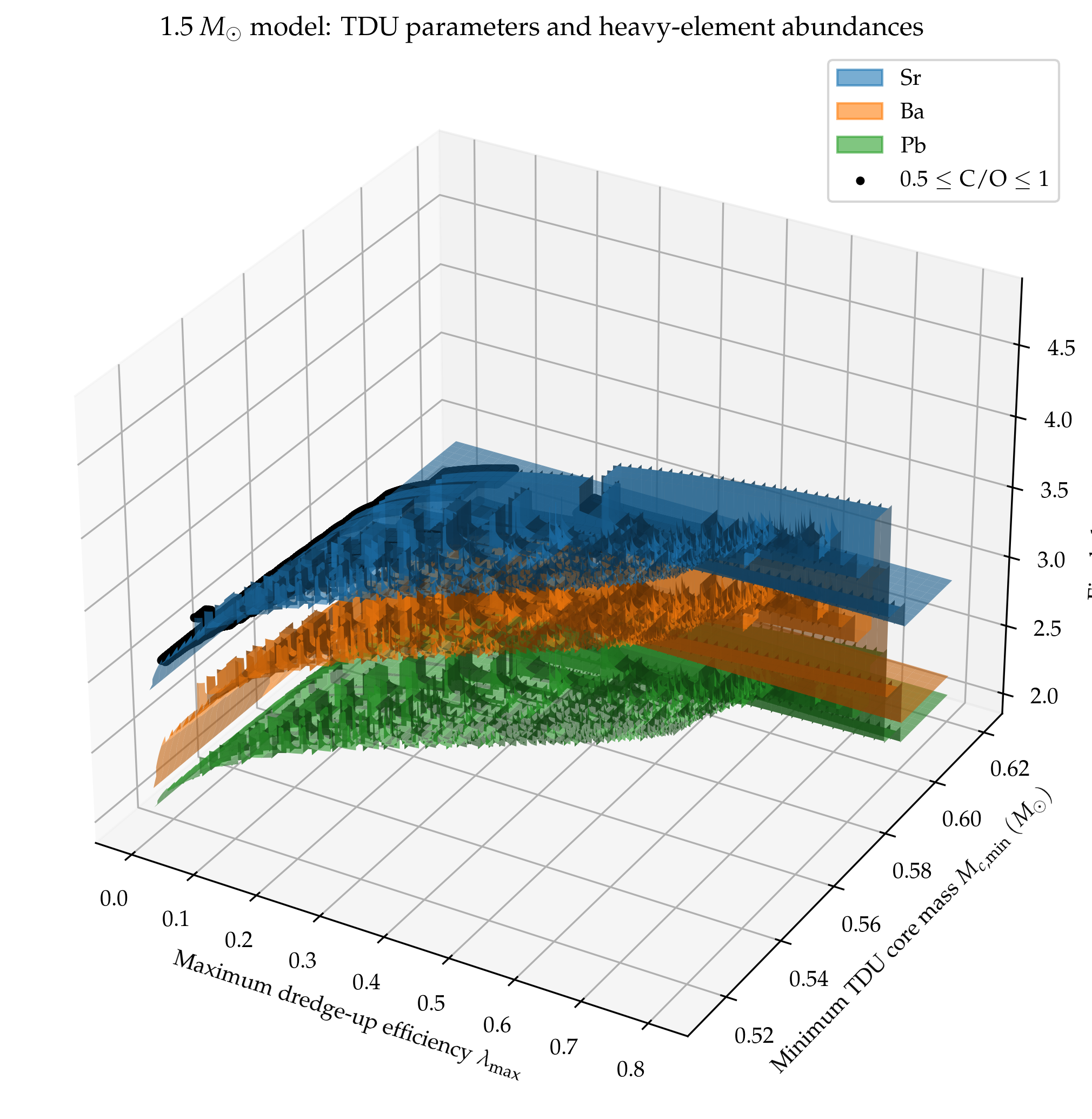
这图已经很明显了:那些凸起来的锯齿明显是因为模拟代码是一个不连续的 toy model,因此仅凭调参肯定会出现 bug;但是大体上已经能够看出趋势.
Mass-loss is also highly uncertain. Going back to the model, try changing the mass-loss rate by increasing it by a factor of , and then reducing it by a factor of . How do the surface compositions change?
明显,增大 mass_loss() 之后 C/O 变少 (其他也相应变化),TDU 开始的时间后移、周期数变少,另外重元素产率也相应降低. 但是每一个 TDU episode 内部的过程没有很大区别.
减小为原来 ,TDU 周期数暴增到 ,和上面完全相反.
How do you think the stellar yields would change as a result of changing i) the amount of TDU, ii) the mass-loss rate on the AGB?
从之前 lecture 中讲到的定义来看就是:TDU 更多 / 更慢的 mass loss 会导致更高 stellar yield. 因为这两种情况 AGB star 都有更多时间来抛出物质,积分的区域变大了.
d6df0-于 a9a17-于