
外观
Lecture 1 Chemodynamics and other
约 2127 字大约 7 分钟
2026-07-28
Prof. Chiaki Kobayashi, from the University of Hertfordshire
警告
由于第一天不太适应加上听不太懂教授的发音,而且前半段试图用手写方式记录但是后来发现效率不够高,漏记错记想必数不胜数,本篇权当试水.
Wolf–Rayet Stars
Wolf–Rayet (WR) stars are evolved massive stars with extremely powerful stellar winds.
These winds strip away most or all of the hydrogen envelope, exposing helium-burning products beneath.
Binary Evolution: Binary mass transfer can also remove the hydrogen envelope. Consequently, even stars with somewhat lower initial masses can become Wolf–Rayet stars.
Supernova Classification
Chemical Enrichment
(fg 是气体分数)
dtd(Zfg)=Metal ejection ratesESW+ESNcc+ESNIaGalaxy Evolutiondecreased by star evolution−Zψinflow+Zinflowoutflow−ZRoutflow
Initial Mass Function (IMF):一般而言这是一个 power law,它是一个经验性的概率分布函数,描述恒星的质量分布. 一般而言它来源于恒星的光度分布,然后再用恒星演化模型来导出.
Is IMF universal?
Ejection rates from SWs and SNe
一颗星,初始质量 m,lifetime τm,剩下的质量 wm,在时刻 (t−τm) 出生、在时刻 t 死亡. 终止质量 (τm=t) 为 mt.
E=∫mtmu(1−wm)ψ(t−τm)ϕ(m)dm
大于终止质量的星体是死掉的星体. SNe 由 nucleosynthesis yields (核合成产率) pzm 给出,
EZ,cc=∫mtmupzmψ(t−τm)ϕ(m)dm
同理,SW 也是一样.
Galactic terms
- Star formation rate: ψ∝fg
- Inflow rate: Rin∝e−t/τ or te−t/τ
- Outflow rate: Rout∝ψ (SN-driven) or ψ=0 for t>tw (AGN-driven)
Numerical Solutions
这里有三种模型:
- Closed:封闭的状态
- Infall:系统不断吸收气体,气体向中心塌缩
- Outflow:气体塌缩的同时还存在 ejection,失去 metal
初始情况都是 fg,0=1. 三种模型的演化曲线有很大的差异. 我们只讨论 one-zone model 情况下的结论,从观测数据来看,[O/Fe] - [Fe/H] 关系有一个开始时比较慢、之后比较快的下降,拟合最好的模型是 infall model.
The Origin of Elements
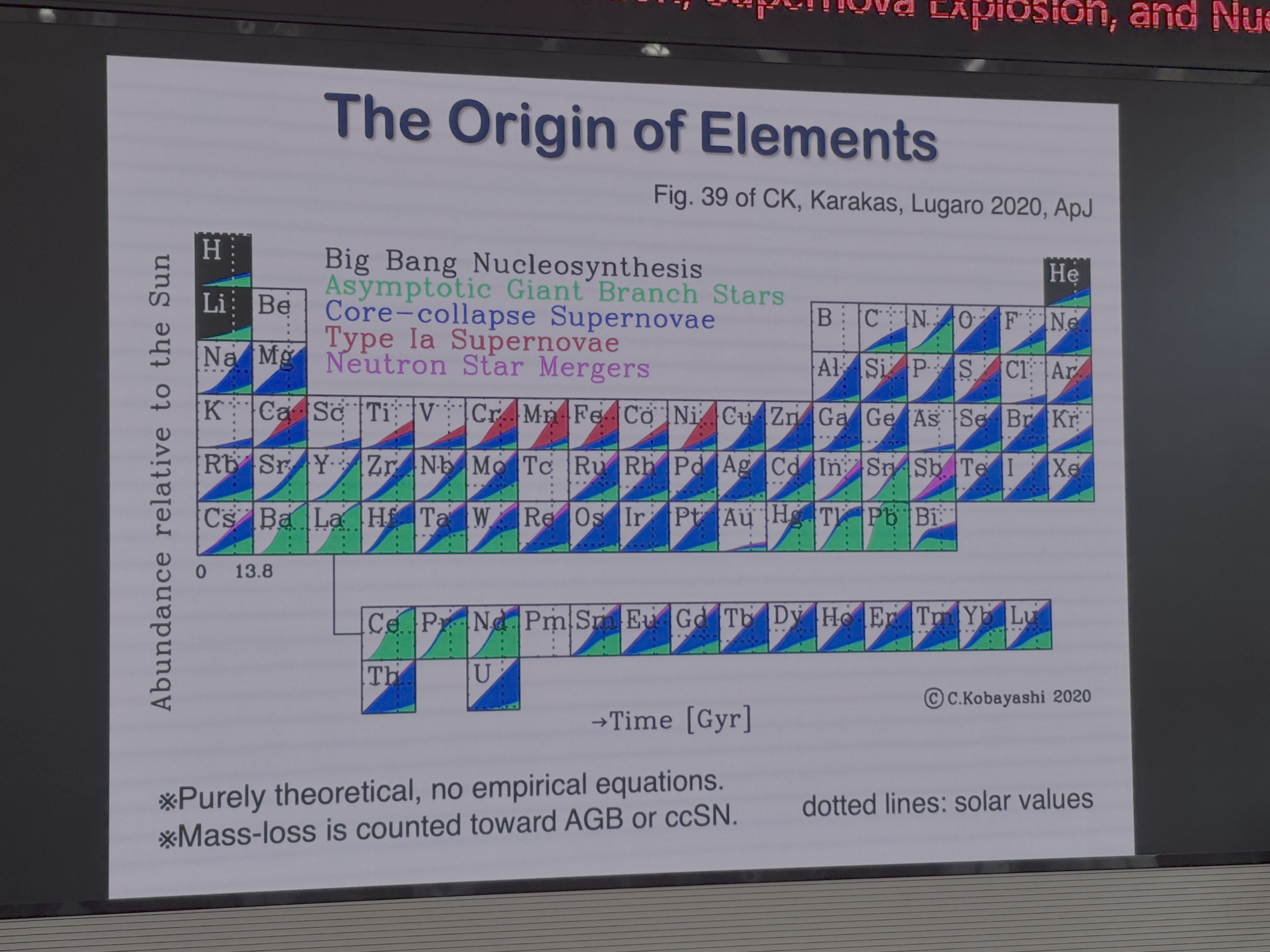
这里 Be 和 B 不包含在模型内,因为它们很多来源于高能量宇宙射线的作用.
NS-NS Merger Model
为了解释银河系内部的 r-process (也就是快中子捕获过程,被认为是产生一半以上重于铁的元素的过程),有一种思路是双中子星并合事件. 但是仍然有很多争议.
GPT's Explanation
The Neutron Star Merger (NSM) model is currently the leading explanation for the production of the heaviest r-process elements (e.g. Au, Pt, Th, U), especially after the discovery of the kilonova associated with GW170817. However, it faces several challenges, and a number of alternative or complementary models have been proposed.
A useful way to organize them is:
Origin of heavy r-process elements
│
├── Neutron Star Mergers (standard model)
│
├── Magnetorotational Supernovae
│
├── Collapsars (Hypernovae)
│
├── Electron-Capture Supernovae
│
├── Neutrino-driven Winds
│
└── Exotic Models
├── Quark nova
├── Primordial black holes
└── OthersBelow are the major competing models.
Magnetorotational Supernovae (Jet Supernovae)
The basic idea is a rapidly rotating massive star with an extremely strong magnetic field collapses.
Instead of producing a roughly spherical explosion, rotation and magnetic fields launch bipolar relativistic jets.
Massive star
↓
Core collapse
↓
Rapid rotation
+ Strong magnetic field
↓
Jet explosion
↓
Neutron-rich ejecta
↓
r-processAdvantages
Very early in Galactic history. Unlike neutron star mergers, so no binary evolution and merger delay. Therefore they naturally explain extremely metal-poor stars and large star-to-star scatter in Eu abundances.
Problems
Very rare.
Requires rapid rotation and magnetic field. Both conditions are uncommon. Simulations still disagree about whether enough neutron-rich material is ejected.
Collapsars
Currently the strongest competitor. The basic idea is a very massive star M≳25∼30,M⊙ collapses directly into a black hole. An accretion disk forms.
Massive star
↓
Black hole
↓
Accretion disk
↓
Disk wind
↓
r-processThis is closely related to
Hypernovae
Long Gamma-Ray Bursts (GRBs)
Advantages
Produces enormous r-process mass. Typically 0.05−0.3,M⊙ per event, much larger than many core-collapse supernovae. Occurs immediately after star formation.
Can explain
early Eu enrichment
high [Eu/Fe]
Galactic chemical evolution.
Problems
Event rate is uncertain. Need enough collapsars without overproducing GRBs.
Neutrino-driven Winds
This was the "classical" model before neutron star mergers became popular.
After core collapse,
Proto-neutron star
↓
Neutrino heating
↓
Neutrino wind
↓
Heavy nucleiThe idea was that neutrino winds become neutron rich.
Problems
Modern simulations generally find Ye is too high.
The ejecta become proton-rich rather than neutron-rich.
Usually only produce Sr, Y, Zr instead of Au, Pt, U.
Thus today they are thought to produce the weak r-process, not the main r-process.
Electron-Capture Supernovae (ECSNe)
Occurs in stars of roughly 8−10,M⊙.
Core collapse begins when e−+24Mg or e−+20Ne captures reduce electron pressure.
Advantages
More common than magnetorotational SNe.
Problems
Ejecta are usually not neutron rich enough.
Mostly produce light trans-iron elements rather than heavy r-process nuclei.
Quark Nova
Very speculative.
Idea
Neutron star
↓
Quark matter transition
↓
Second explosion
↓
Neutron-rich ejectaCould in principle create ideal r-process conditions.
No convincing observational evidence exists.
Primordial Black Hole Scenarios
Another speculative idea. Tiny primordial black holes interact with neutron stars. This can eject neutron-rich matter.
But current observational support is essentially absent.
Why was NSM challenged?
The biggest historical problem was time delay.
Neutron star mergers require
Massive binary
↓
Two supernovae
↓
Binary inspiral
↓
MergerThe inspiral time may be 108−109 yr.
However, very metal-poor stars [Fe/H]<−3 already contain Eu and Ba, indicating r-process enrichment almost immediately after star formation.
This motivated prompt sources like magnetorotational supernovae or collapsars.
Today, population synthesis and the discovery of fast-merging binaries suggest that some neutron star mergers can occur within only a few to tens of Myr, reducing (though not completely eliminating) this tension.
Current Consensus
Rather than a single source, most researchers now favor multiple r-process sites.
Heavy r-process
│
├── Neutron star mergers
│ ✔ Main contributor today
│
├── Collapsars
│ ✔ Possibly important in early galaxies
│
├── Magnetorotational SNe
│ ✔ Rare but prompt
│
└── Ordinary CCSNe
✔ Weak r-process onlyThe main debate today is not whether neutron star mergers produce r-process elements —— GW170817 established that they do —— but whether they are sufficient to explain all Galactic r-process enrichment, especially in the earliest generations of stars. Many recent Galactic chemical evolution models therefore combine neutron star mergers with a prompt source, most commonly collapsars or magnetorotational supernovae, to reproduce both the abundance patterns and the observed evolution of Eu with metallicity.
Chemodynamics
对于一个 UV 背景辐射,考虑一团正在冷却的气体,星体形成条件为
- ∇⋅v<0
- tcool<tdyn
- tdyn<tsound
有多个过程构成一个循环,进行元素的生成.
这里有好几种模拟方法:
- Direct summation —— O(N2)
midt2d2xi=j=i∑Gmimj∣xj−xi∣3xj−xi
- 网格数值法
- ……
- SPH Method (Smoothed-particle hydrodynamics,平滑粒子流体力学):处理大尺度的流体模拟比较有效,不需要建立一个网格来进行计算.
Cosmological 'Zoom in' Simulation
展示了一个完整的星系形成过程:从最初的气体到形成 disk,最终的结构中能看到 thin disk 和中间的 bulge,以及 halo (通过卫星星系来体现).
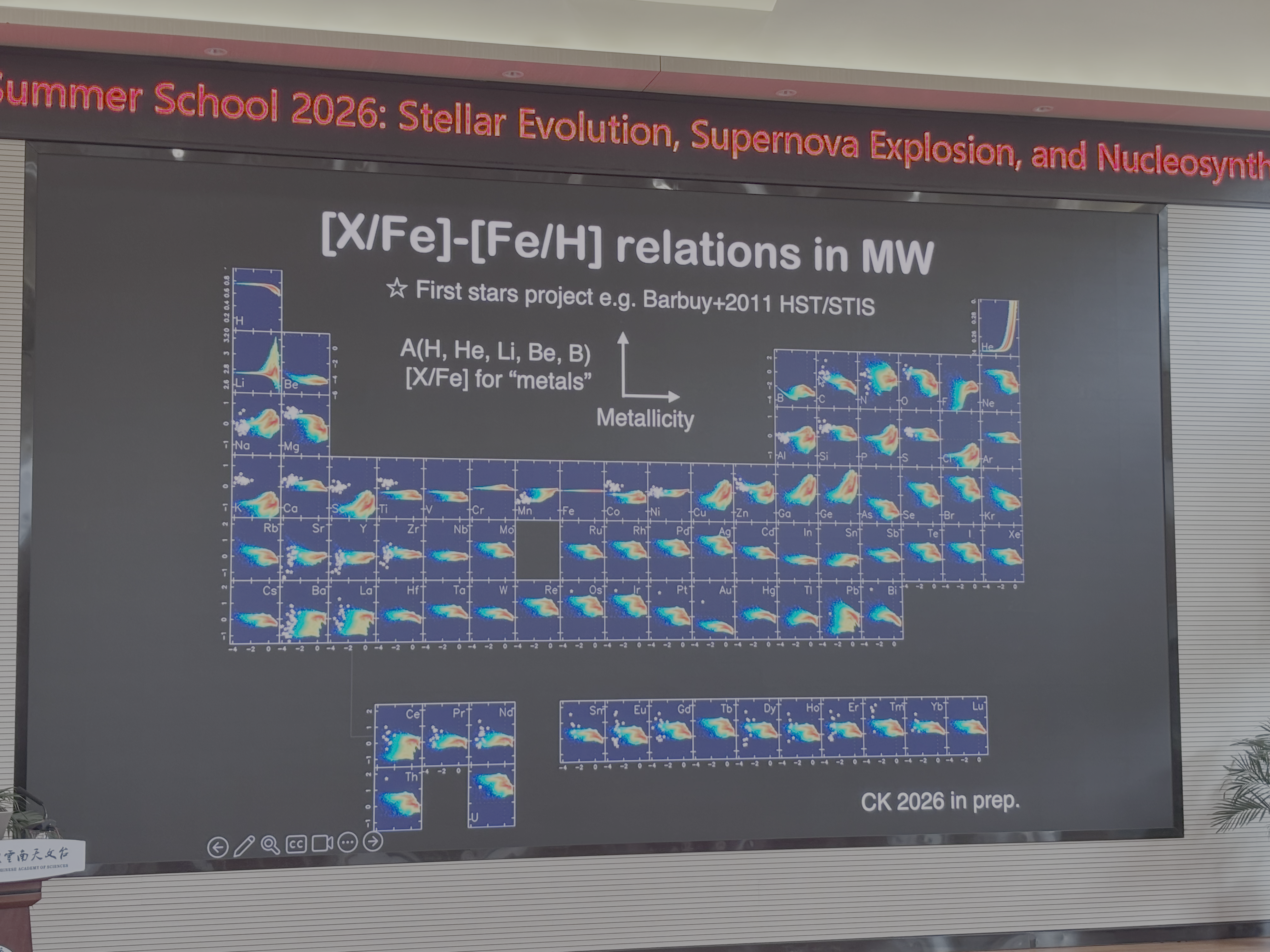
Inhomogenous Enrichment
The scatter of [X/Fe] at given [Fe/H] is increased / decreased by
- 动力学效应导致的 star mixing
- Local variation in flows
- Stellar yields depend on M, Z, E rot. of stars (intrinsic variation, 固有的差异)
- ISM may be mixed before the next star formation by other effects like diffusion / turbulence (涡流)
因此,不会存在 strong age-metallicity relation;另外,大多数 metal-poor stars 不是最老的那一批恒星.
more explanation on「大多数 metal-poor stars 不是最老的那一批恒星」:
根据模拟的数据 (Age-Metallicity relation figure),可以观察到这些恒星确实处于年龄较大的那一批恒星中,但是并不是最老的恒星.
我们说这个结论实际上是想纠正观测上的一些常识性的错误认知.
Extra-Galactic Archaeology
这个领域 thanks to JWST,是一个非常新的领域.
具体的做法是,对整个星系做光谱,看吸收线. 但是难点在于 UV 的光谱本来就足够 faint,因此难以在地面上完成光谱观测,只能用空间望远镜.
……技术层面的东西……
Mass-Metallicity Relation (MZR)
在红移比较高的情况下 (我们说这是 z 在 7∼11 左右),JWST 给出了某种联系. 在之前的观测数据中,人们发现 mass, metallicity, SFR (Star Forming Rate) 三者构成的立体图中,星系基本处于一个曲面上.
Cosmologic Simulation
其实和之前的化学动力学类似,仍然有这个过程:
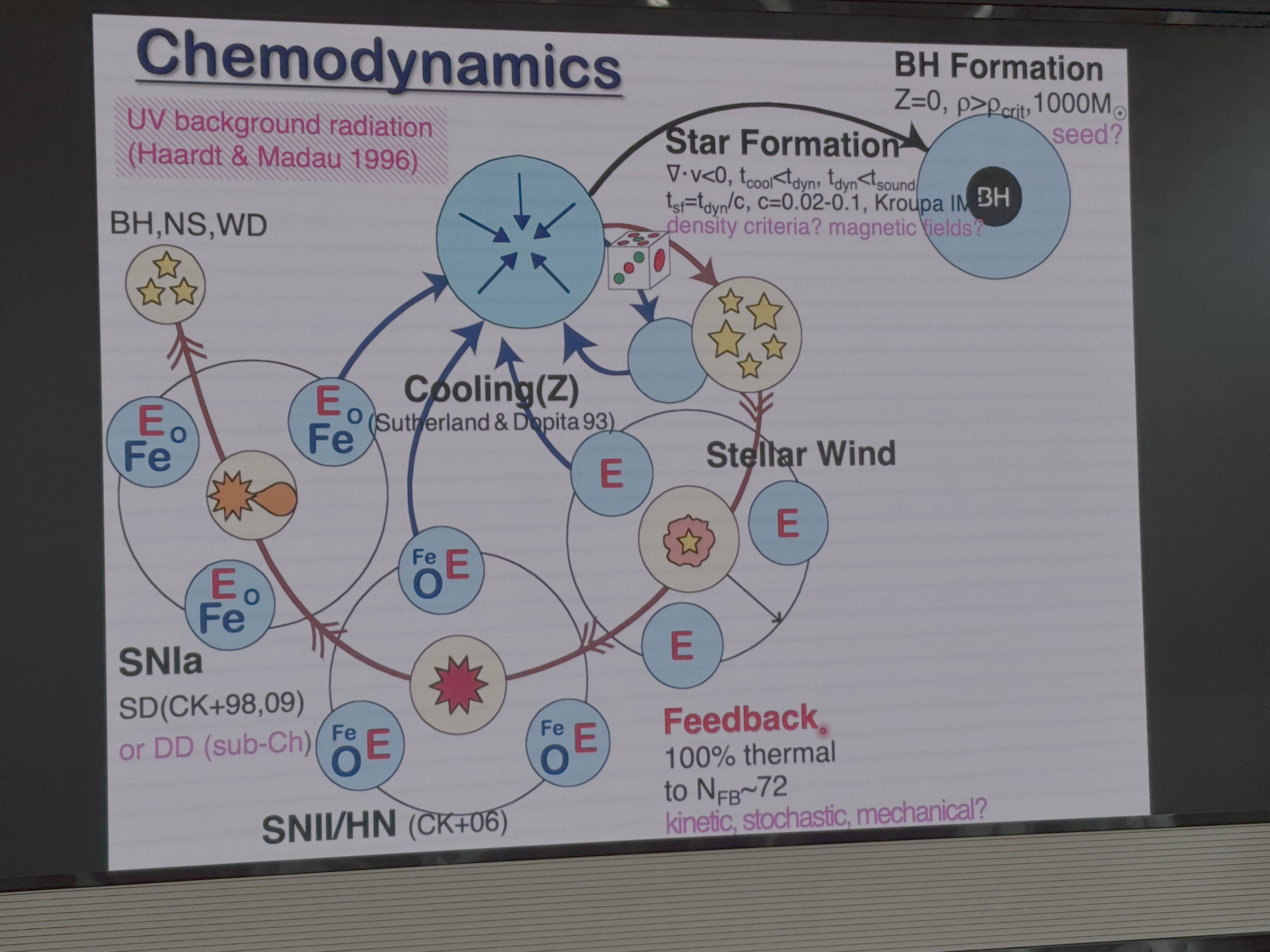
这个过程在前面 Chemodynamics 那个部分也提到了.
这里唯一的区别在于这里多了一个 Black Hole 的效应.
Reference
更新日志
2026/7/28 15:29
查看所有更新日志
a9a17-chore(pnpm): update pnpm; feat(notes): add icesun summer school notes于
